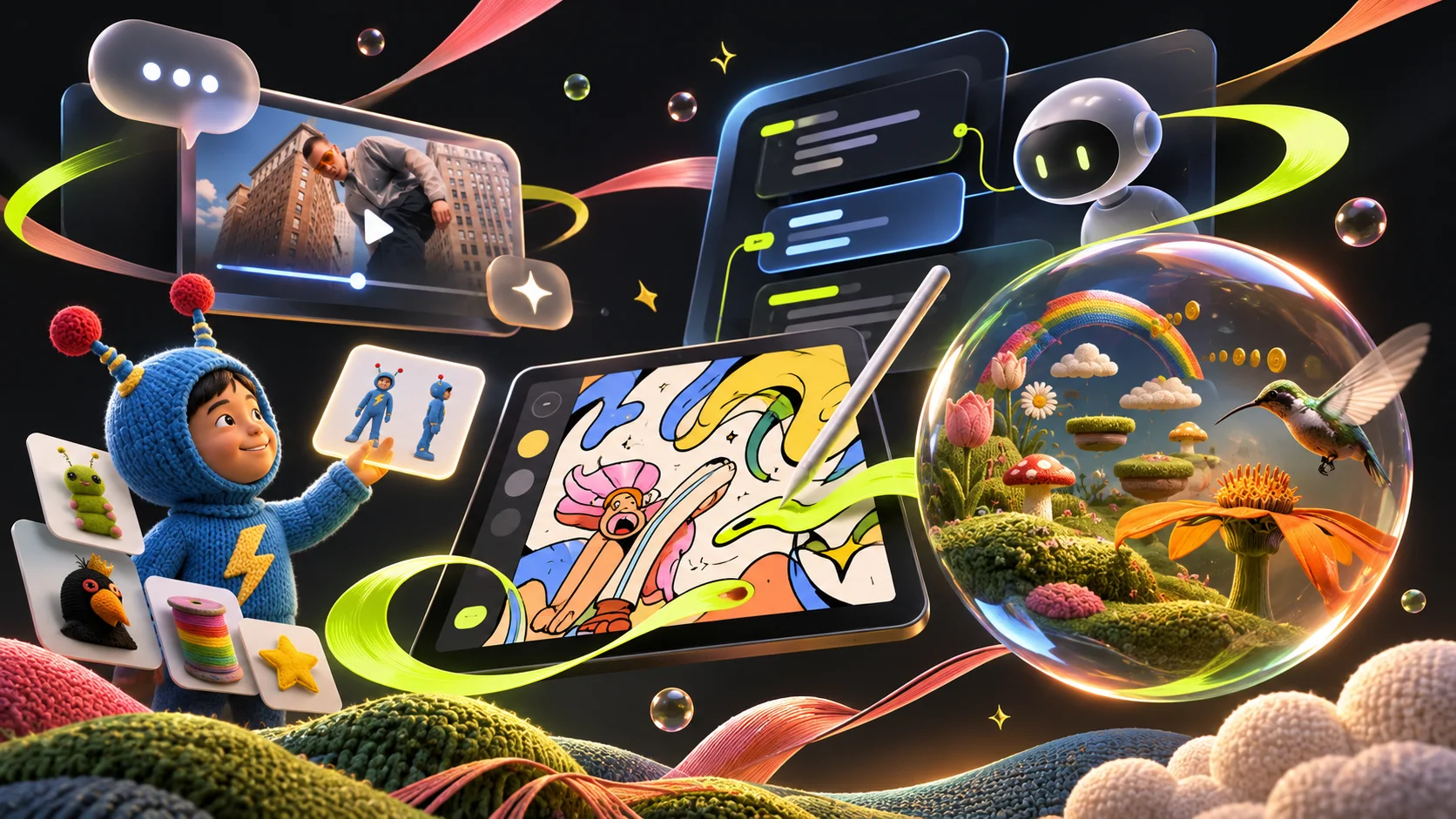
Two announcements on 3 November move creative production closer to the surfaces where a brief begins. Synthesia’s ChatGPT plugin can turn a prompt or document into a video draft without leaving the conversation. Affinity for iPad keeps sketch, vector, pixel and layout work in one touch-first file, with optional AI controls for selected editing tasks.
Briefs are becoming working interfaces
Synthesia shortens the route from source material to a reviewable video, while retaining an explicit hand-off into Studio for exact scripts, templates and brand controls. Runway’s coding-agent plugins make a related move for software teams: a developer can describe a generative-media feature inside an editor, then use Runway’s models and account context to build the integration.
Both changes can remove an early hand-off. Neither makes the output automatically correct, cleared or ready to publish. A production workflow still needs approved inputs, version control, cost limits, review gates and a clear record of who accepted the result.
Editability matters more than a one-shot result
Affinity’s single-file approach keeps drawing, image work and layout connected. Pika H3 Flex approaches the same production problem from video: references guide the picture and sound, while separate dialogue, score, effects, Foley and ambience stems preserve room for an editor to rebalance the result.
Apple’s connected video, image and music tools, Meshy’s local 3D edits and ElevenLabs’ layered sound work reinforce the pattern across the wider collection. The useful unit is not the generation button. It is a revision that can survive the next hand-off.
Live simulation broadens previsualisation
Google DeepMind’s Genie 4 extends the idea into a live world that can be directed while it runs. Its near-term creative value is previsualisation and concept testing, where a team can explore a camera path, atmosphere or interaction before a conventional build. Google also identifies consistency, physics, spatial accuracy, text and audio as continuing research problems.
What creative teams should test
Choose one bounded task and follow it from approved source to final review. Check factual accuracy, rights, brand treatment, captions, typography, colour, layer structure, audio stems, file exchange and failure handling. For UAE and Saudi work, include Arabic and English typography, reading direction and subtitle timing in the same test.
The collection does not show that creative direction has become automatic. It shows that AI tools are becoming more useful when they enter a familiar surface and leave the work editable, reviewable and attributable.
Referenced stories and primary sources
- Synthesia brings AI video creation into ChatGPT · Synthesia
- Affinity brings touch-first AI editing into one iPad design file · Canva / Affinity
- Runway brings generative-media workflows into coding agents · Runway
- Pika H3 Flex brings reference-led AI video and separate audio stems · Pika
- Google’s Genie 4 turns scene direction into real-time world simulation · Google DeepMind
Sources checked 4 November 2026. Product capabilities remain attributed to their publishers; Genie 4 is identified as a research preview.