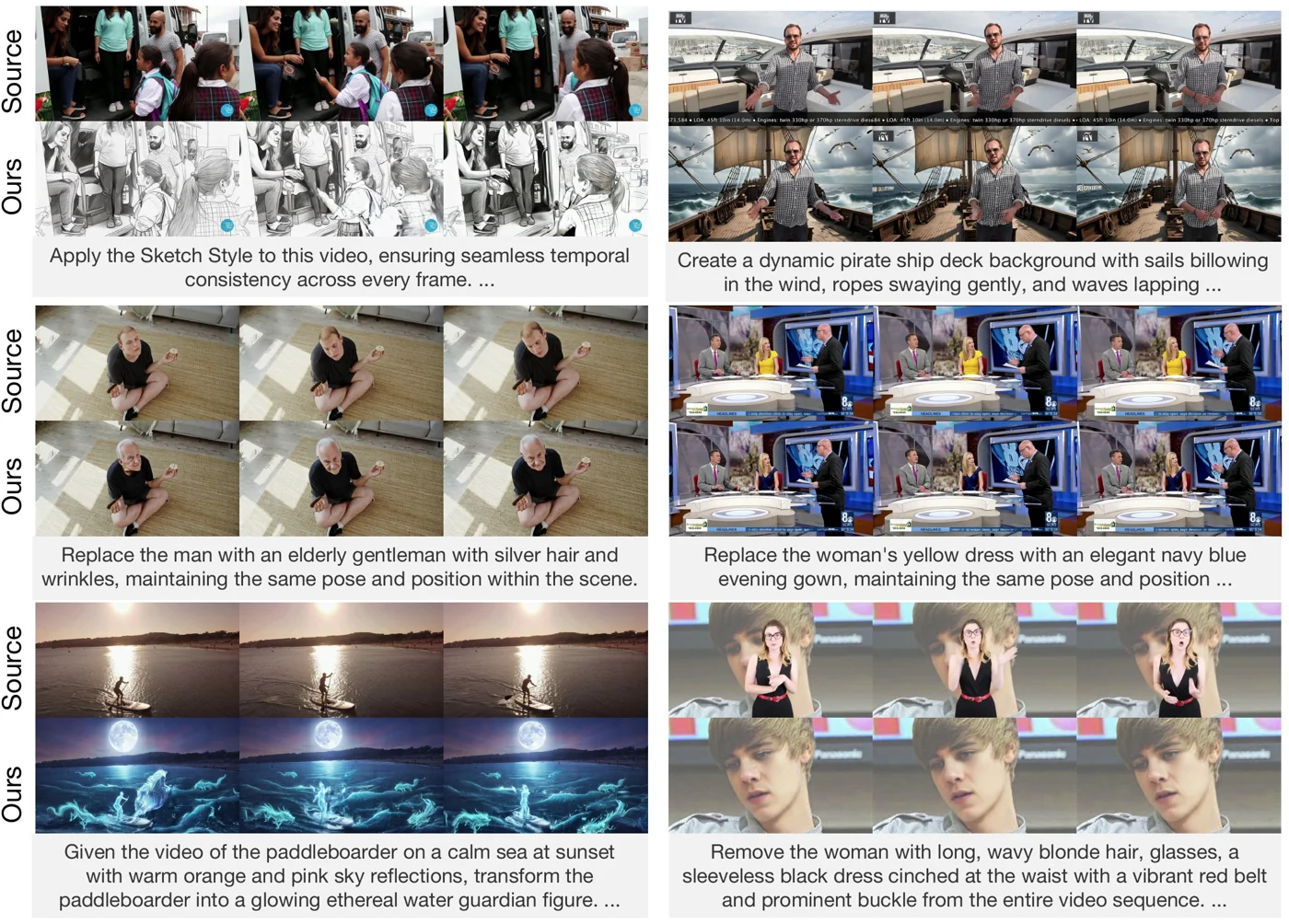
A VINCIE-NExT paper submitted on 8 October describes transferring editing capability from images to video. Its framework breaks the task into a video-to-image-to-image-to-video chain, using an image-editing pair as a visual demonstration for subsequent frames.
The authors’ project page shows examples and identifies camera editing as a limitation. These are research results and author-reported demonstrations, not a commercial release or an independent production benchmark.
What it means for creative production
The creative appeal is specific: show the desired appearance in a frame, then ask whether that intent can survive through a moving shot. That could make a reference image a more precise discussion tool than a long verbal instruction.
For production teams, the hard questions remain temporal consistency, occlusion and fidelity to approved details. A convincing still does not establish that a whole sequence will hold together. Review beginning, middle and end frames, fast motion and transitions before drawing conclusions. This research is worth watching as a direction for editable video; it is not a reason to promise a client a capability that has not been validated on their footage.
Primary sources
Researchers from NUS, ByteDance Seed and USTC · Verified 20 October 2026.